From Samurai legacy to Cyberpunk skyline
Every turn on the bus route reveals a new layer of Tokyo's fascinating transformation over the centuries.
Table of Contents
Edo: The Origins of a Capital
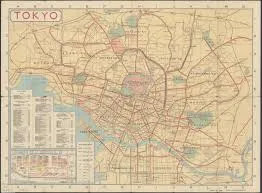
Before it was the neon megalopolis we know today, Tokyo was a small fishing village named Edo. In 1603, the Tokugawa Shogunate established its military government here, transforming it into the de facto capital of Japan. During the Edo period, the city grew rapidly, becoming one of the largest cities in the world with over a million inhabitants by the 18th century. As your bus winds through the city center, you are driving over the footprints of samurai estates and merchant quarters that laid the chaotic, organic foundation for the modern street layout.
The spirit of 'Edo'—marked by a vibrant merchant culture, kabuki theater, and ukiyo-e art—still pulses beneath the concrete. While fires and earthquakes have claimed much of the original wooden architecture, the layout of the moats, the names of the districts, and the shitamachi (downtown) atmosphere in places like Asakusa preserve the memory of that bygone era.
The Imperial Palace & Marunouchi
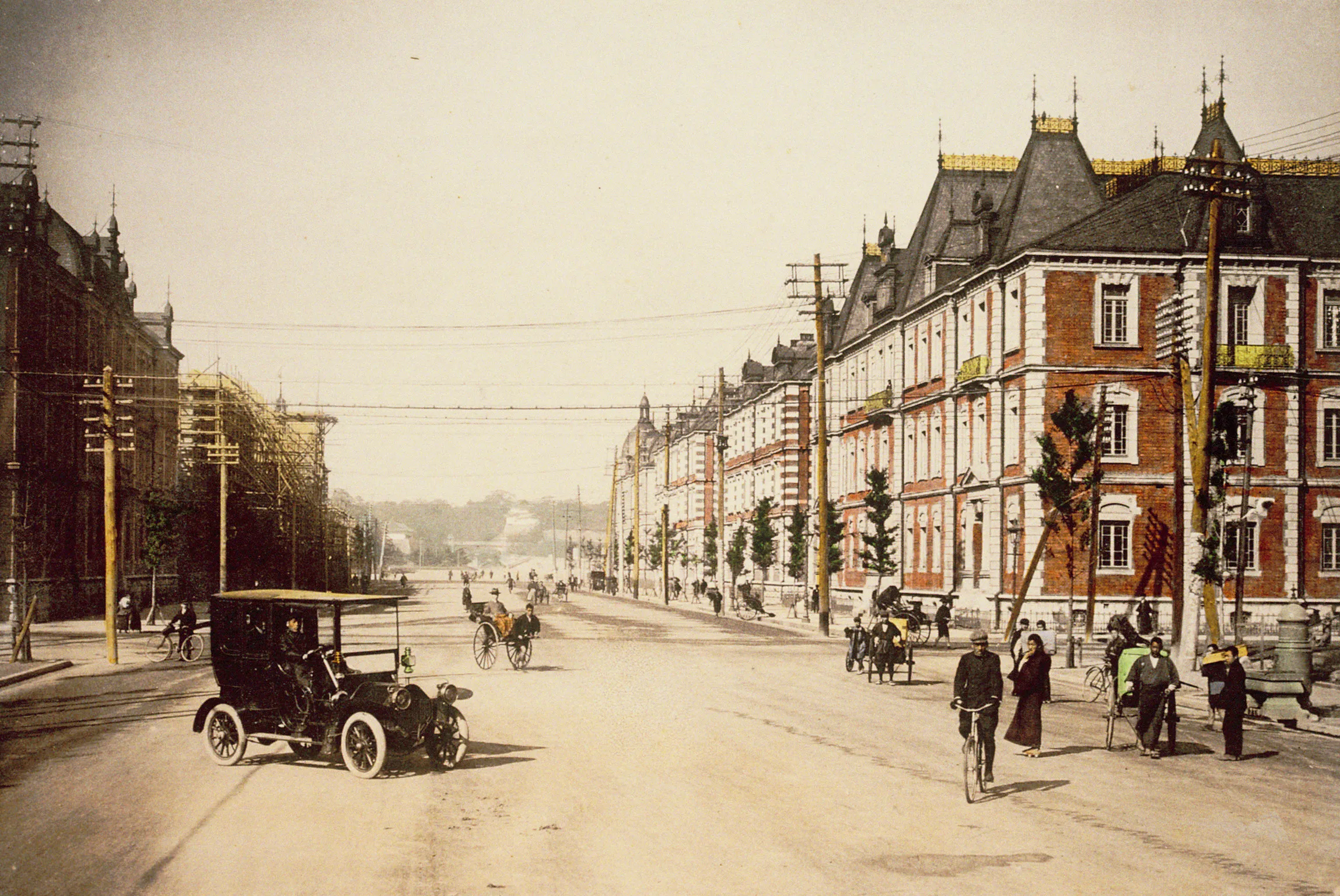
A highlight of many routes is the drive past the Imperial Palace East Gardens. This site was once Edo Castle, the massive fortress of the Shogun. Today, it is the residence of the Emperor of Japan. The sheer scale of the stone walls and the width of the moats visible from the bus give you a sense of the power once held here. The contrasting backdrop of Marunouchi's sleek glass business towers illustrates perfectly the harmony of tradition and modernity that defines Japan.
Marunouchi itself is a testament to Japan's modernization. Once a grassy field, it became the country's first office district, modeled after London's Lombard Street. The red-brick Tokyo Station building, restored to its original splendor, anchors this district and serves as a grand starting point for your journey.
Tokyo Tower: A Symbol of Rebirth
Rising 333 meters into the sky, the red and white lattice of Tokyo Tower is unmistakable. Built in 1958, it was a symbol of Japan's post-war economic recovery and optimism. Inspired by the Eiffel Tower but painted in international orange for aviation safety, it remains a beloved icon. As the bus approaches the tower, look up to see the intricate steelwork that has watched over the city's rapid vertical growth for decades.
Though the newer and taller Tokyo Skytree has taken over the role of primary broadcasting tower, Tokyo Tower retains a romantic, nostalgic charm. It marks the Shiba Park area, home to the ancient Zojo-ji Temple, where the Tokugawa Shoguns are buried—another striking juxtaposition of the sacred and the structural.
Asakusa: The Entertainment District of Old
As the bus heads east towards the Sumida River, you enter the 'Shitamachi' or 'Low City. Asakusa is the heart of this area, centered around Senso-ji, Tokyo's oldest temple. Legend has it that in the year 628, two brothers fished a statue of Kannon, the goddess of mercy, out of the river, and the temple was built to honor her. For centuries, this area was the playground of Edo, filled with theaters, teahouses, and festivals.
From the upper deck, you can see the bustling Nakamise-dori shopping street, teeming with visitors buying rice crackers and folding fans. It's one of the best places to hop off and feel the atmosphere of a festival that seems to never end. The nearby Asakusa Culture Tourist Information Center offers a free viewing deck that looks straight down onto the temple approach.
Akihabara: From Black Market to Electric Town
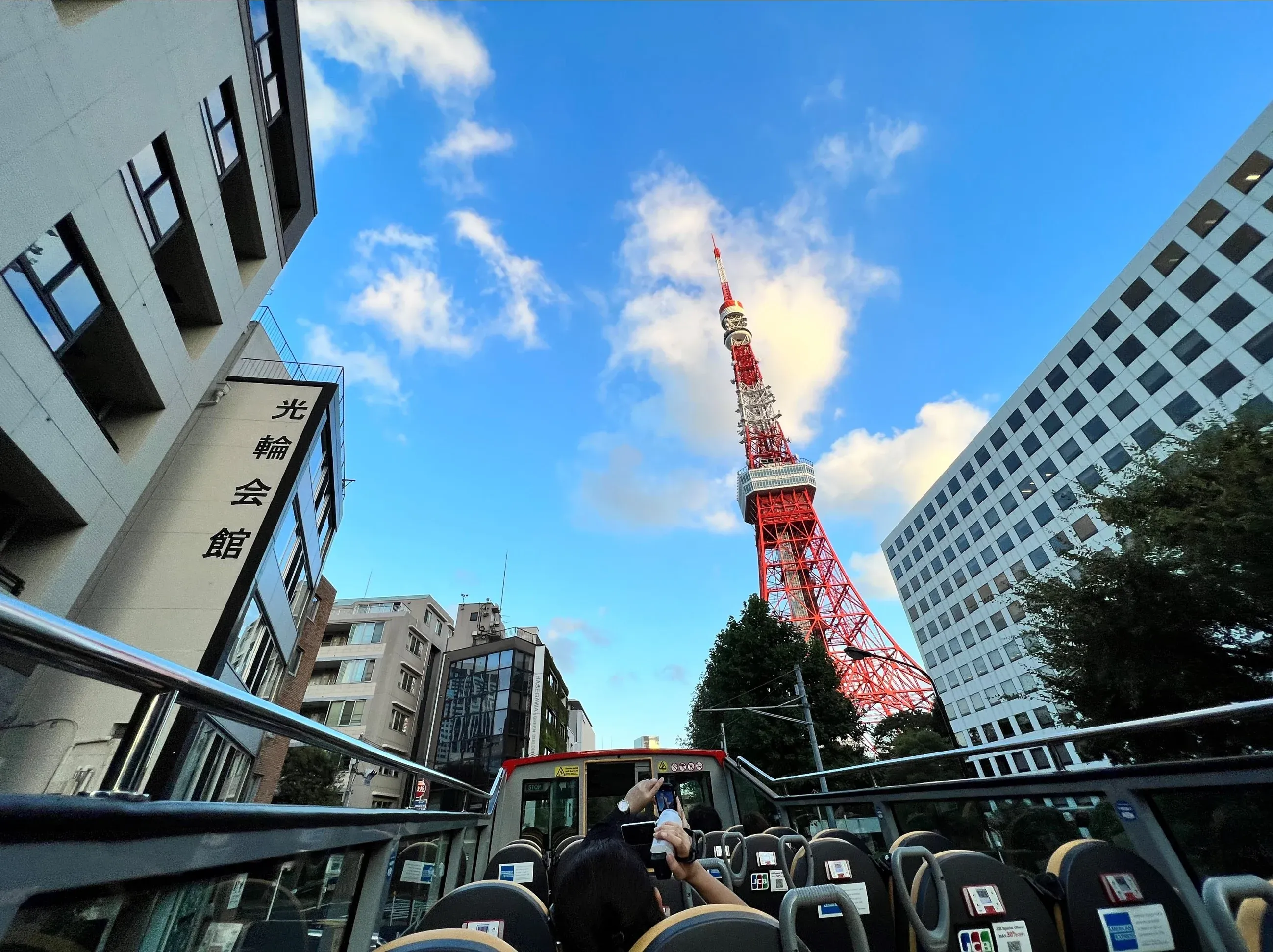
Leaving the traditional behind, the bus may cruise through Akihabara. Originally a black market for radio parts after WWII, it evolved into 'Electric Town,' the place to buy household appliances. In recent decades, it has morphed again into the global mecca for otaku (geek) culture. The streets are lined with multi-story arcades, maid cafes, and shops selling everything from vintage video games to rare figurines.
Even if you aren't into anime, the visual overload of Akihabara is a quintessential Tokyo experience. The massive billboards and the energetic soundscape of shop jingles create a sensory immersion that is best experienced from the open air of the bus.
Ginza: The Window to the West
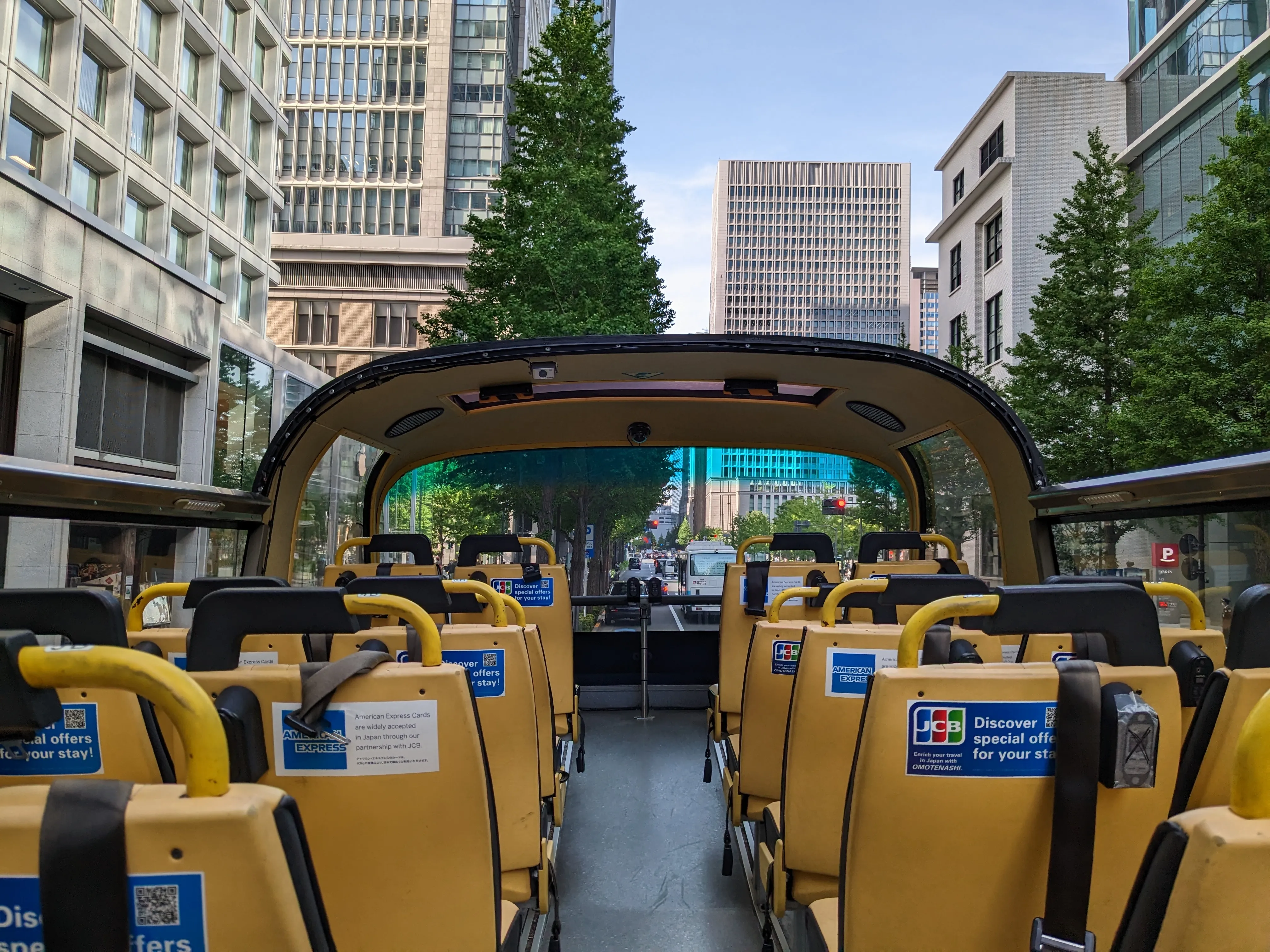
Ginza is where Japan first embraced Western trends in the late 19th century. After a devastating fire in 1872, the government rebuilt the district with brick buildings and paved streets, creating a model of modernization. Today, it is arguably the most expensive real estate in Japan, home to flagship stores of global luxury brands and historic department stores like Mitsukoshi and Wako with its iconic clock tower.
On weekends, the main street is closed to traffic, becoming a 'pedestrian paradise.' Riding through Ginza, you can admire the cutting-edge architecture of buildings like the Ginza Place or the Hermès glass block building, which glow elegantly at night.
Crossing the Rainbow Bridge to Odaiba
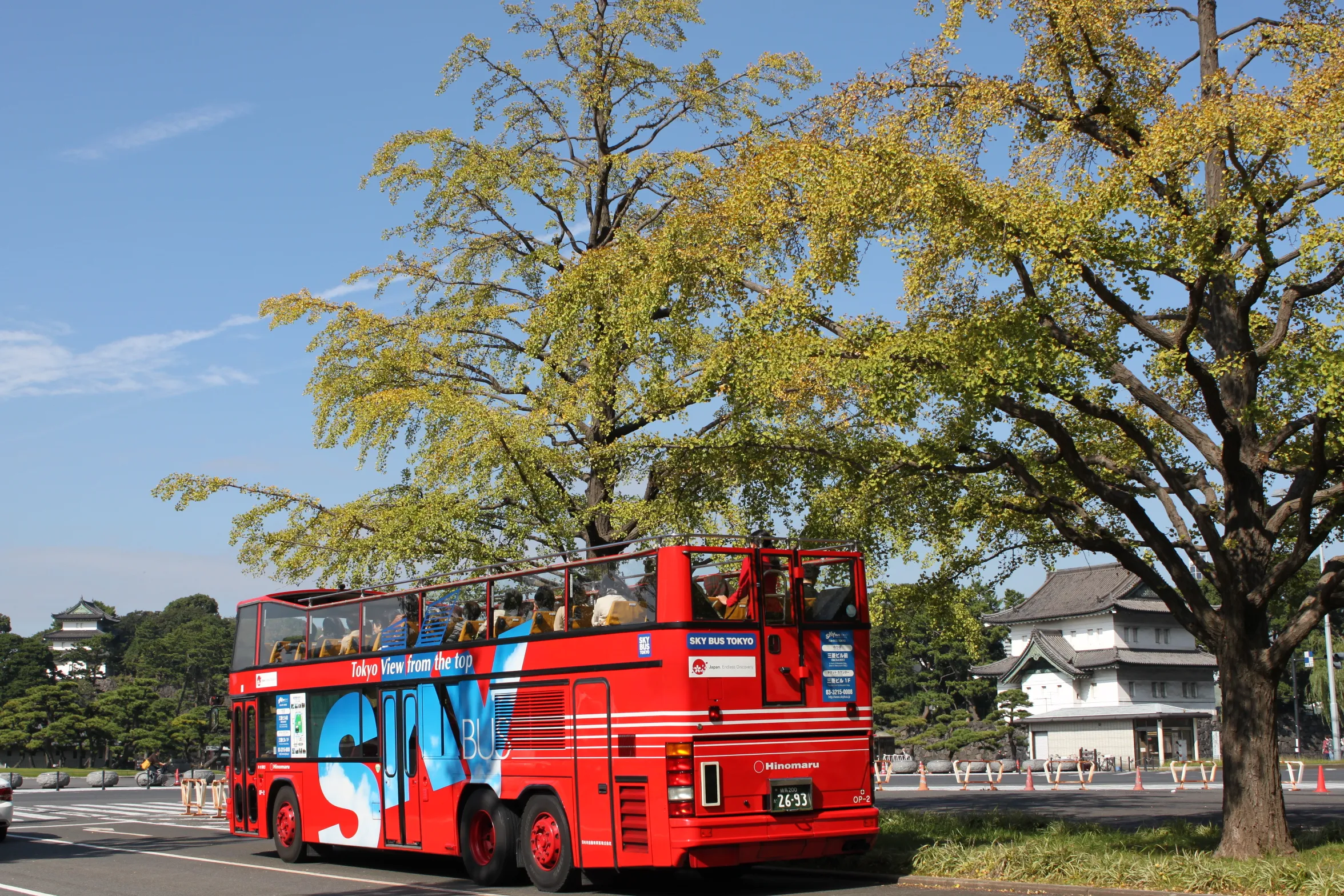
For a breath of fresh air, the route crossing the Rainbow Bridge to the artificial island of Odaiba is spectacular. As the bus climbs the loop to the bridge, you get sweeping views of the Tokyo Bay, the skyline, and on clear days, even a silhouette of Mount Fuji in the distance. Odaiba itself is a futuristic entertainment hub, built on reclaimed land that was originally a series of forts (daiba) to protect Edo from naval attacks.
The open breeze on the bridge is refreshing, and the view of the city reflected in the water is unmatched. It's a reminder of Tokyo's identity as a port city, constantly expanding outward into the sea.
Shibuya & Harajuku: Youth Culture Central
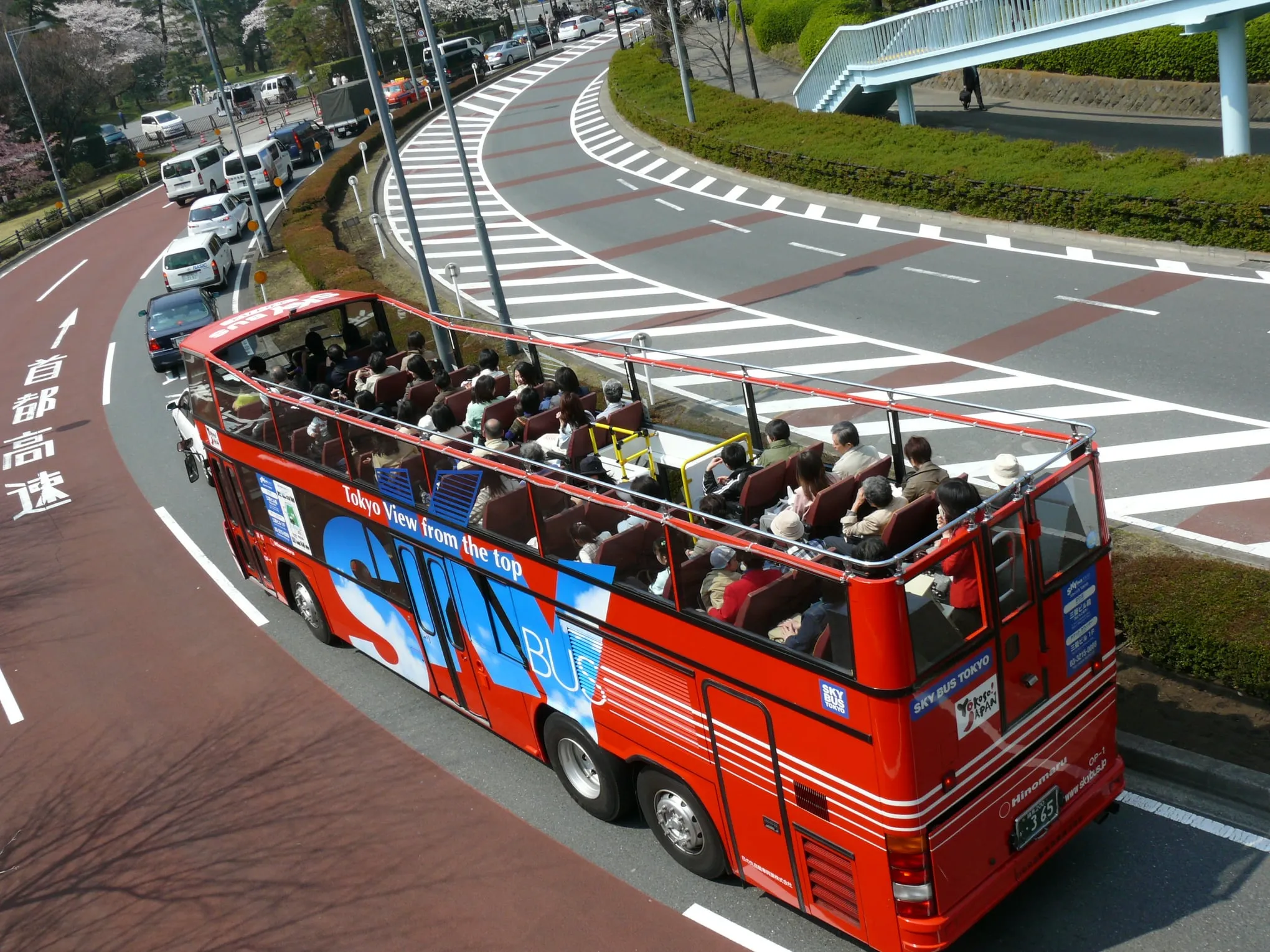
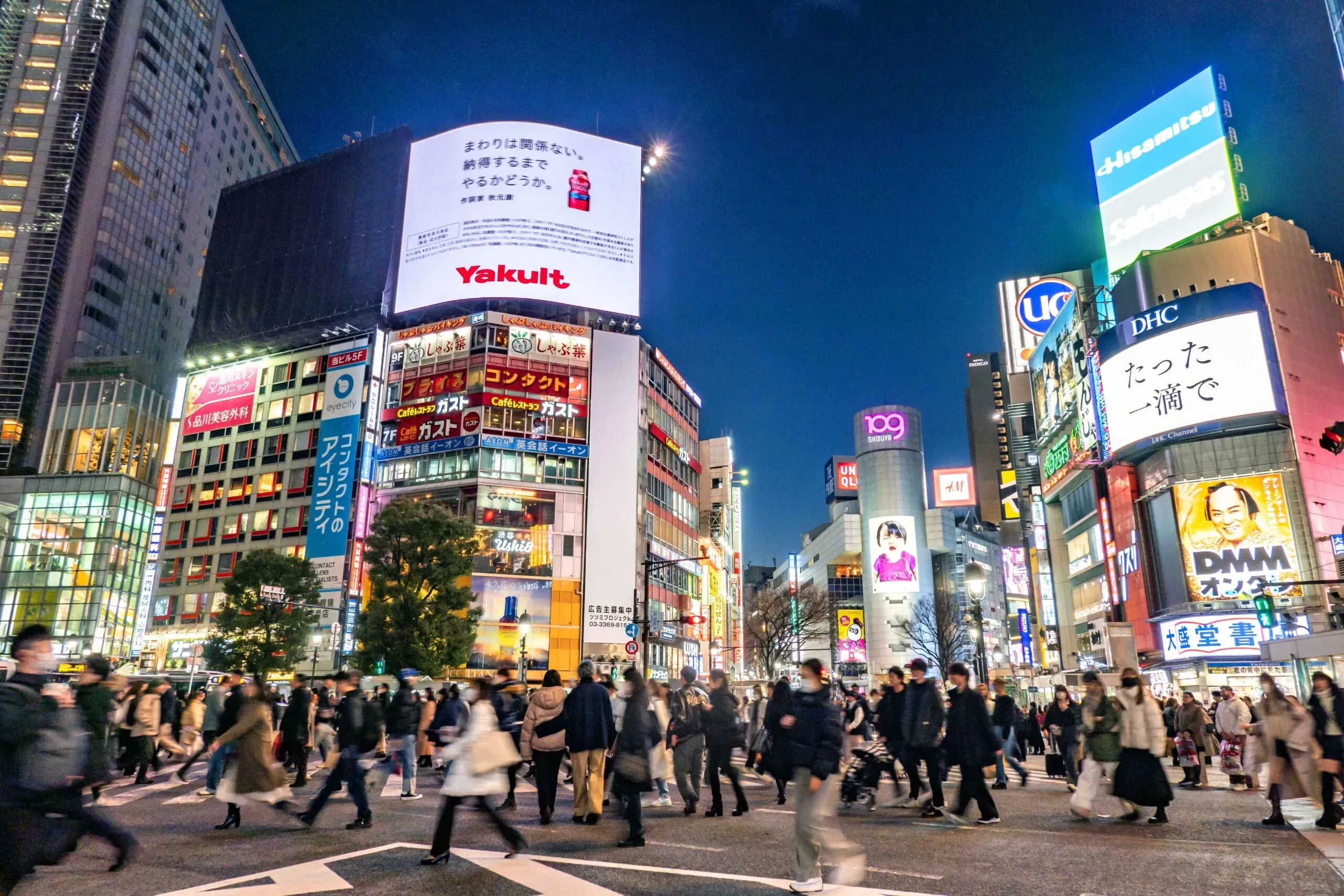
Some routes venture west to the pulsing heart of youth culture. Shibuya is famous for its 'Scramble Crossing,' often called the busiest intersection in the world. Watching the tide of pedestrians flood the street from the high vantage point of a bus is mesmerizing. Nearby Harajuku is the cradle of kawaii (cute) fashion, where trends are born on Takeshita Street.
This area is also home to the serene Meiji Jingu Shrine, a vast forest in the city center dedicated to Emperor Meiji. The contrast between the hyper-commercial streets and the sacred forest is a defining characteristic of this area.
Ueno: Culture, Art & Park Life
Ueno Park is the cultural lungs of the city. Established as one of Japan's first public parks, it houses the Tokyo National Museum, the National Museum of Western Art, and the Ueno Zoo. In spring, it transforms into a sea of pink as thousands of cherry trees bloom, drawing massive crowds for hanami (flower viewing) parties.
The bus drives along the edge of the park and the nearby Ameyoko market, a vibrant, somewhat gritty market street that originated as a post-war black market. The shouts of fishmongers and the smell of street food offer a lively counterpoint to the quiet museums.
The Spirit of Resilience
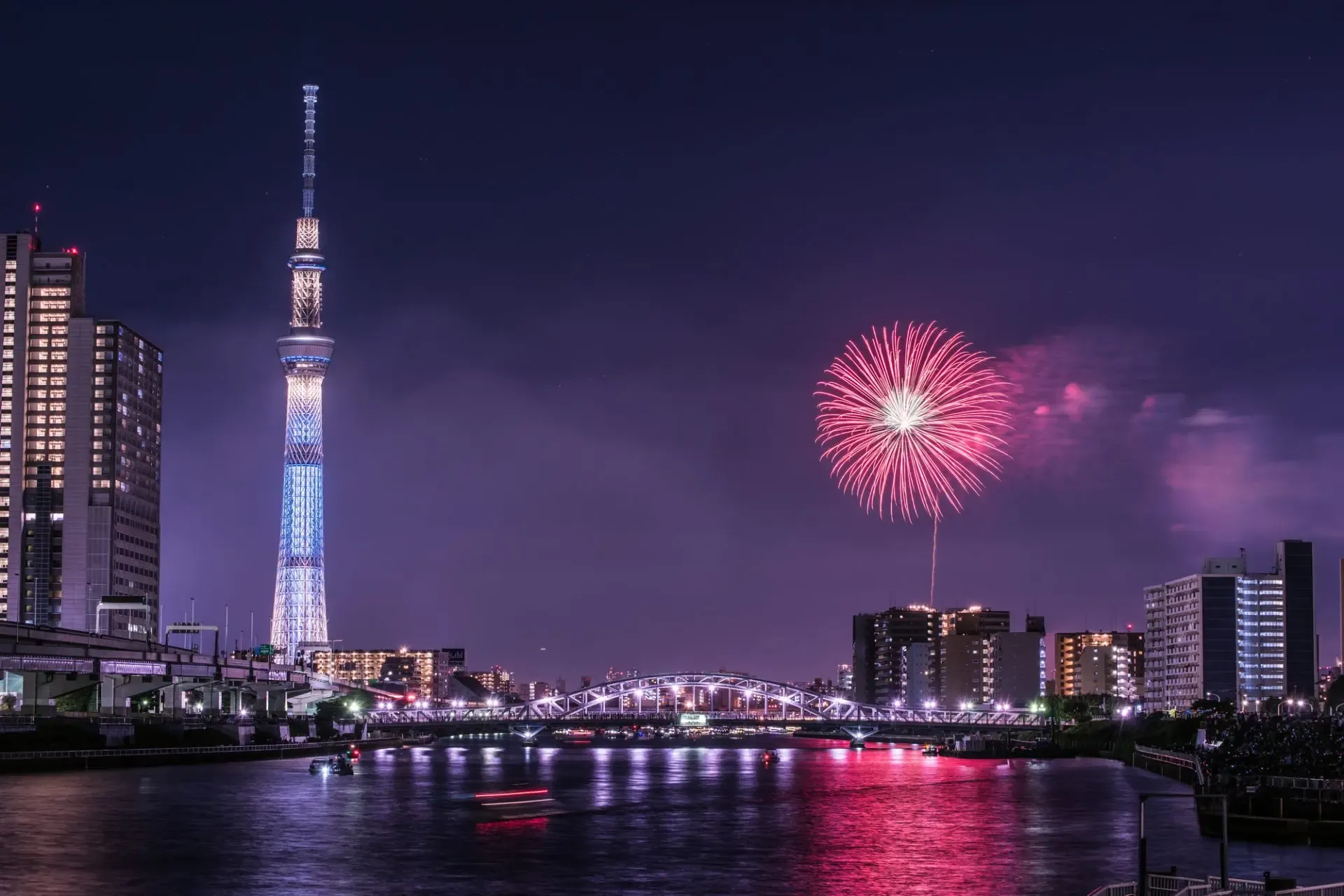
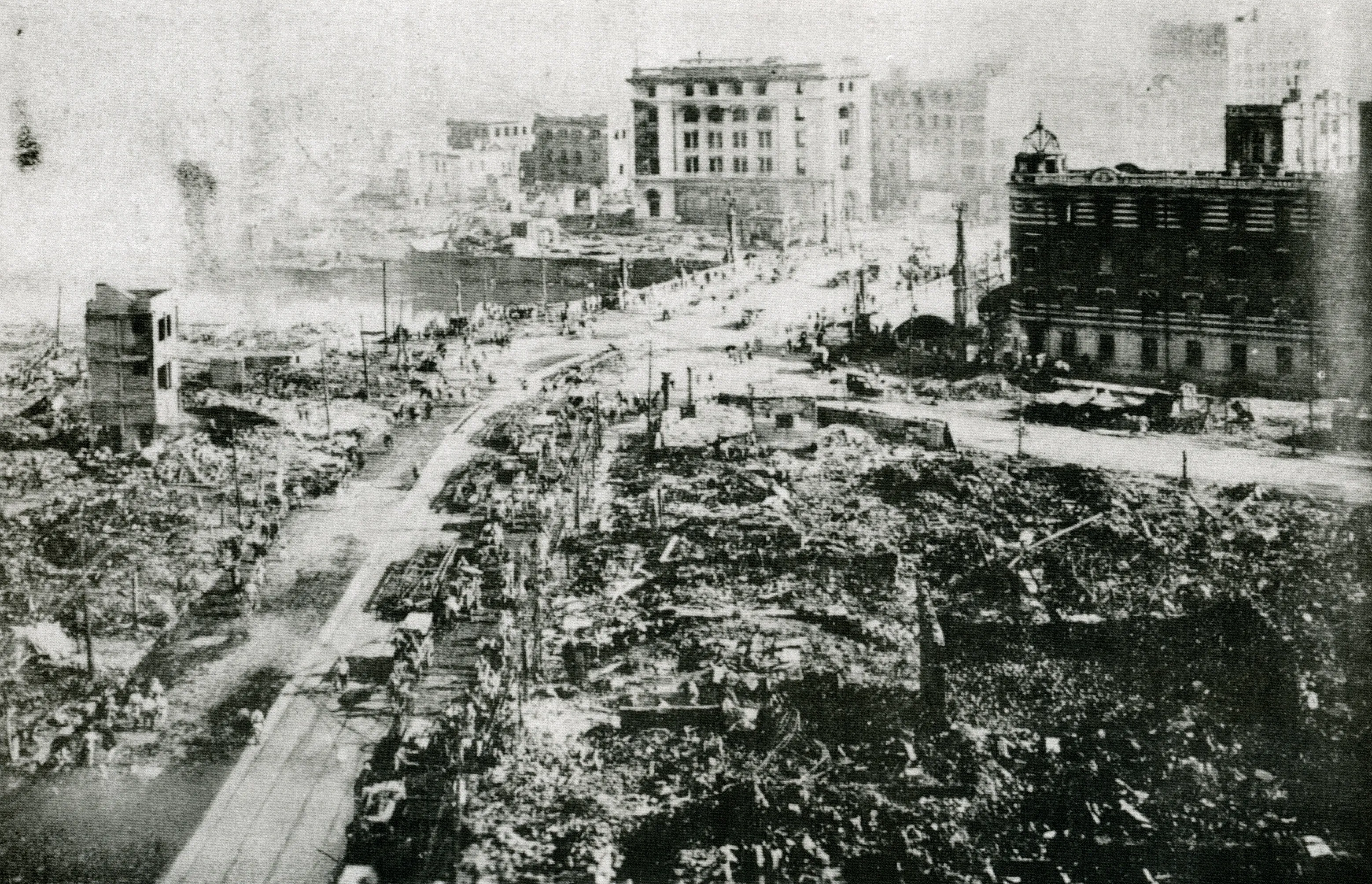
Tokyo is a city that has risen from the ashes twice in the last century—first after the Great Kanto Earthquake of 1923, and again after the firebombings of World War II. Its skyline is not just a collection of buildings but a testament to resilience and reinvention. The constant construction and renewal you see from the bus are part of the city's DNA.
This continual cycle of destruction and rebirth means Tokyo lacks the preserved medieval center of European cities, but possesses a dynamic, ever-changing energy that is thrilling to witness.
Modern Tokyo & The 2020 Legacy
The preparation for the 2020 Olympics brought another wave of development, including the new National Stadium designed by Kengo Kuma, which blends wood and steel in a distinctly Japanese style. The bus route often passes these new landmarks, showcasing how the city continues to evolve and modernize its infrastructure while trying to harmonize with nature.
New developments like the Shibuya Scramble Square or the Takanawa Gateway station area show a future-focused Tokyo that prioritizes verticality and connectivity.
Day Trips & Extensions
While the hop-on hop-off bus keeps you in the city, Tokyo is the launchpad for greater adventures. Many visitors use their pass to navigate to major stations like Shinjuku or Tokyo Station, from where they catch the Shinkansen to Kyoto, or an express train to Nikko or Hakone. The bus gives you the lay of the land, helping you understand the geography before you branch out further.
Don't forget that from Tokyo, Disneyland and DisneySea are just a short train ride away, and the historic town of Kamakura with its Giant Buddha is an easy day trip.
Seeing the City Whole
In a city as fragmented and vast as Tokyo, it's easy to get 'tunnel vision,' seeing only the inside of subway cars and the immediate area around stations. The hop-on hop-off bus stitches these disconnected islands together. It reveals the gradients between neighborhoods—how the business suits of Otemachi fade into the rare booksellers of Jimbocho, or how the glitz of Omotesando softens into the quiet residential streets of Aoyama.
Ultimately, the ride offers a narrative thread through the chaotic tapestry of Tokyo. It allows you to sit back, rise above the crowds, and watch the greatest show on earth—the daily life of 14 million people—unfold before your eyes.
Table of Contents
Edo: The Origins of a Capital
Before it was the neon megalopolis we know today, Tokyo was a small fishing village named Edo. In 1603, the Tokugawa Shogunate established its military government here, transforming it into the de facto capital of Japan. During the Edo period, the city grew rapidly, becoming one of the largest cities in the world with over a million inhabitants by the 18th century. As your bus winds through the city center, you are driving over the footprints of samurai estates and merchant quarters that laid the chaotic, organic foundation for the modern street layout.
The spirit of 'Edo'—marked by a vibrant merchant culture, kabuki theater, and ukiyo-e art—still pulses beneath the concrete. While fires and earthquakes have claimed much of the original wooden architecture, the layout of the moats, the names of the districts, and the shitamachi (downtown) atmosphere in places like Asakusa preserve the memory of that bygone era.
The Imperial Palace & Marunouchi
A highlight of many routes is the drive past the Imperial Palace East Gardens. This site was once Edo Castle, the massive fortress of the Shogun. Today, it is the residence of the Emperor of Japan. The sheer scale of the stone walls and the width of the moats visible from the bus give you a sense of the power once held here. The contrasting backdrop of Marunouchi's sleek glass business towers illustrates perfectly the harmony of tradition and modernity that defines Japan.
Marunouchi itself is a testament to Japan's modernization. Once a grassy field, it became the country's first office district, modeled after London's Lombard Street. The red-brick Tokyo Station building, restored to its original splendor, anchors this district and serves as a grand starting point for your journey.
Tokyo Tower: A Symbol of Rebirth
Rising 333 meters into the sky, the red and white lattice of Tokyo Tower is unmistakable. Built in 1958, it was a symbol of Japan's post-war economic recovery and optimism. Inspired by the Eiffel Tower but painted in international orange for aviation safety, it remains a beloved icon. As the bus approaches the tower, look up to see the intricate steelwork that has watched over the city's rapid vertical growth for decades.
Though the newer and taller Tokyo Skytree has taken over the role of primary broadcasting tower, Tokyo Tower retains a romantic, nostalgic charm. It marks the Shiba Park area, home to the ancient Zojo-ji Temple, where the Tokugawa Shoguns are buried—another striking juxtaposition of the sacred and the structural.
Asakusa: The Entertainment District of Old
As the bus heads east towards the Sumida River, you enter the 'Shitamachi' or 'Low City. Asakusa is the heart of this area, centered around Senso-ji, Tokyo's oldest temple. Legend has it that in the year 628, two brothers fished a statue of Kannon, the goddess of mercy, out of the river, and the temple was built to honor her. For centuries, this area was the playground of Edo, filled with theaters, teahouses, and festivals.
From the upper deck, you can see the bustling Nakamise-dori shopping street, teeming with visitors buying rice crackers and folding fans. It's one of the best places to hop off and feel the atmosphere of a festival that seems to never end. The nearby Asakusa Culture Tourist Information Center offers a free viewing deck that looks straight down onto the temple approach.
Akihabara: From Black Market to Electric Town
Leaving the traditional behind, the bus may cruise through Akihabara. Originally a black market for radio parts after WWII, it evolved into 'Electric Town,' the place to buy household appliances. In recent decades, it has morphed again into the global mecca for otaku (geek) culture. The streets are lined with multi-story arcades, maid cafes, and shops selling everything from vintage video games to rare figurines.
Even if you aren't into anime, the visual overload of Akihabara is a quintessential Tokyo experience. The massive billboards and the energetic soundscape of shop jingles create a sensory immersion that is best experienced from the open air of the bus.
Ginza: The Window to the West
Ginza is where Japan first embraced Western trends in the late 19th century. After a devastating fire in 1872, the government rebuilt the district with brick buildings and paved streets, creating a model of modernization. Today, it is arguably the most expensive real estate in Japan, home to flagship stores of global luxury brands and historic department stores like Mitsukoshi and Wako with its iconic clock tower.
On weekends, the main street is closed to traffic, becoming a 'pedestrian paradise.' Riding through Ginza, you can admire the cutting-edge architecture of buildings like the Ginza Place or the Hermès glass block building, which glow elegantly at night.
Crossing the Rainbow Bridge to Odaiba
For a breath of fresh air, the route crossing the Rainbow Bridge to the artificial island of Odaiba is spectacular. As the bus climbs the loop to the bridge, you get sweeping views of the Tokyo Bay, the skyline, and on clear days, even a silhouette of Mount Fuji in the distance. Odaiba itself is a futuristic entertainment hub, built on reclaimed land that was originally a series of forts (daiba) to protect Edo from naval attacks.
The open breeze on the bridge is refreshing, and the view of the city reflected in the water is unmatched. It's a reminder of Tokyo's identity as a port city, constantly expanding outward into the sea.
Shibuya & Harajuku: Youth Culture Central
Some routes venture west to the pulsing heart of youth culture. Shibuya is famous for its 'Scramble Crossing,' often called the busiest intersection in the world. Watching the tide of pedestrians flood the street from the high vantage point of a bus is mesmerizing. Nearby Harajuku is the cradle of kawaii (cute) fashion, where trends are born on Takeshita Street.
This area is also home to the serene Meiji Jingu Shrine, a vast forest in the city center dedicated to Emperor Meiji. The contrast between the hyper-commercial streets and the sacred forest is a defining characteristic of this area.
Ueno: Culture, Art & Park Life
Ueno Park is the cultural lungs of the city. Established as one of Japan's first public parks, it houses the Tokyo National Museum, the National Museum of Western Art, and the Ueno Zoo. In spring, it transforms into a sea of pink as thousands of cherry trees bloom, drawing massive crowds for hanami (flower viewing) parties.
The bus drives along the edge of the park and the nearby Ameyoko market, a vibrant, somewhat gritty market street that originated as a post-war black market. The shouts of fishmongers and the smell of street food offer a lively counterpoint to the quiet museums.
The Spirit of Resilience
Tokyo is a city that has risen from the ashes twice in the last century—first after the Great Kanto Earthquake of 1923, and again after the firebombings of World War II. Its skyline is not just a collection of buildings but a testament to resilience and reinvention. The constant construction and renewal you see from the bus are part of the city's DNA.
This continual cycle of destruction and rebirth means Tokyo lacks the preserved medieval center of European cities, but possesses a dynamic, ever-changing energy that is thrilling to witness.
Modern Tokyo & The 2020 Legacy
The preparation for the 2020 Olympics brought another wave of development, including the new National Stadium designed by Kengo Kuma, which blends wood and steel in a distinctly Japanese style. The bus route often passes these new landmarks, showcasing how the city continues to evolve and modernize its infrastructure while trying to harmonize with nature.
New developments like the Shibuya Scramble Square or the Takanawa Gateway station area show a future-focused Tokyo that prioritizes verticality and connectivity.
Day Trips & Extensions
While the hop-on hop-off bus keeps you in the city, Tokyo is the launchpad for greater adventures. Many visitors use their pass to navigate to major stations like Shinjuku or Tokyo Station, from where they catch the Shinkansen to Kyoto, or an express train to Nikko or Hakone. The bus gives you the lay of the land, helping you understand the geography before you branch out further.
Don't forget that from Tokyo, Disneyland and DisneySea are just a short train ride away, and the historic town of Kamakura with its Giant Buddha is an easy day trip.
Seeing the City Whole
In a city as fragmented and vast as Tokyo, it's easy to get 'tunnel vision,' seeing only the inside of subway cars and the immediate area around stations. The hop-on hop-off bus stitches these disconnected islands together. It reveals the gradients between neighborhoods—how the business suits of Otemachi fade into the rare booksellers of Jimbocho, or how the glitz of Omotesando softens into the quiet residential streets of Aoyama.
Ultimately, the ride offers a narrative thread through the chaotic tapestry of Tokyo. It allows you to sit back, rise above the crowds, and watch the greatest show on earth—the daily life of 14 million people—unfold before your eyes.